Viscosity models
HK2003
Porosity.HK2003 Type
HK2003(T, P, dg, σ, ϕ, Ch2o_ol = 0.)Calculate strain rate and viscosity for steady state olivine flow, per Hirth and Kohlstedt (2003), using the three creep mechanisms, i.e., diffusion, dislocation, grain boundary sliding
Arguments
- `T` : Temperature of the rock (K)
- `P` : Pressure (GPa)
- `dg`: Grain size (μm)
- `σ` : Shear stress (GPa)
- `ϕ` : Porosity
Optional Arguments
- `Ch2o_ol` : Water concentration in olivine (ppm), defaults to 0 ppm.Keyword Arguments
- `params` : Various coefficients required for calculation.
Coefficients for different mechanisms (stored in `mechs` field):
    - `diff` : Diffusion creep
    - `disl` : Dislocation creep
    - `gbs`  : Grain boundary sliding
To investigate coefficients, call `default_params(Val{HK2003})`.
To modify coefficients, check the relevant documentation page. This
will also users to get any particular type of mechanism, eg. `diff` only
by setting the `A` in `disl` and `gbs` to `0f0`.

`params` for `HK2003` holds another important field:
- `melt_enhancement` : TODO
Usage
julia> T = collect(1073.0f0:40:1273.0f0);

julia> P = 2 .+ zero(T);

julia> dg = collect(3.0f0:8.0f-1:7.0f0);

julia> σ = collect(7.5f0:1.0f0:12.5f0) .* 1.0f-3;

julia> ϕ = collect(1.0f-2:2.0f-3:2.0f-2);

julia> model = HK2003(T, P, dg, σ, ϕ)
Model : HK2003
Temperature (K) : Float32[1073.0, 1113.0, 1153.0, 1193.0, 1233.0, 1273.0]
Pressure (GPa) : Float32[2.0, 2.0, 2.0, 2.0, 2.0, 2.0]
grain size(μm) : Float32[3.0, 3.8, 4.6, 5.4, 6.2, 7.0]
Shear stress (GPa) : Float32[0.0075000003, 0.0085, 0.009500001, 0.010500001, 0.011500001, 0.0125]
Porosity : Float32[0.01, 0.012, 0.014, 0.016, 0.018, 0.02]
Water concentration in olivine (ppm) : 0.0

julia> forward(model, [])
Rock physics Response : RockphyViscous
Strain rate : Float32[3.152961f-11, 9.076501f-11, 2.643556f-10, 7.560147f-10, 2.093749f-9, 5.5805227f-9]
Viscosity (Pa s) : Float32[2.3787166f17, 9.364843f16, 3.5936449f16, 1.3888621f16, 5.4925405f15, 2.2399335f15]
References
- Hirth and Kohlstedt, 2003, "Rheology of the Upper Mantle and the Mantle Wedge: A View from the Experimentalists", Inside the Subduction Factory, J. Eiler (Ed.). https://doi.org/10.1029/138GM06
Varying grain size
The distribution with temperature looks like (assuming increase in grain size is independent of other parameters) at 2 GPa pressure with a porosity of 0.015:
Code for this figure
f = Figure(; size=(700, 400))

T = (600:1600) .+ 273.0
P = 2.0
dg = [1.0, 3.0, 10.0, 30.0]'
σ = 10e-3
ϕ = 0.015

m = HK2003(T, P, dg, σ, ϕ)
resp = forward(m, []);

resp_fields = [:ϵ_rate, :η]
units = ["", "(Pa s)"]

ax_coords = [(1, 1), (1, 2)]
for i in eachindex(resp_fields)
    ax = Axis(f[ax_coords[i]...]; xlabel="10⁴/T (K⁻¹)",
        ylabel=string(resp_fields[i]) * " $(units[i])",
        yticks=LogTicks(WilkinsonTicks(6; k_min=5)), backgroundcolor=(:magenta, 0.052))

    xts = inv.([600, 800, 1000, 1200, 1600] .+ 273.0) .* 1e4

    ax2 = Axis(
        f[ax_coords[i]...]; xaxisposition=:top, yaxisposition=:right, xlabel="T (ᴼC)",
        xgridvisible=false, xtickformat=x -> string.(round.((1e4 ./ x) .- 273)),
        xticklabelsize=8, backgroundcolor=(:magenta, 0.05))
    ax2.xticks = xts
    hidespines!(ax2)
    hideydecorations!(ax2)
    linkyaxes!(ax, ax2)
    ylims!(ax, extrema(getfield(resp, resp_fields[i])) .* (0.3, 3))
    ylims!(ax2, extrema(getfield(resp, resp_fields[i])) .* (0.3, 3))
    ax.yscale = log10
    ax2.yscale = log10

    for j in axes(getfield(resp, resp_fields[i]), 2)
        d = dg[j]
        r_ = getfield(resp, resp_fields[i])
        lines!(ax, inv.(T) .* 1e4, r_[:, j]; label="$d")
        lines!(ax2, inv.(T) .* 1e4, r_[:, j]; alpha=0)
    end
end
f[2, 1:2] = Legend(f, f.content[end - 1], "grain size (μm)"; orientation=:horizontal)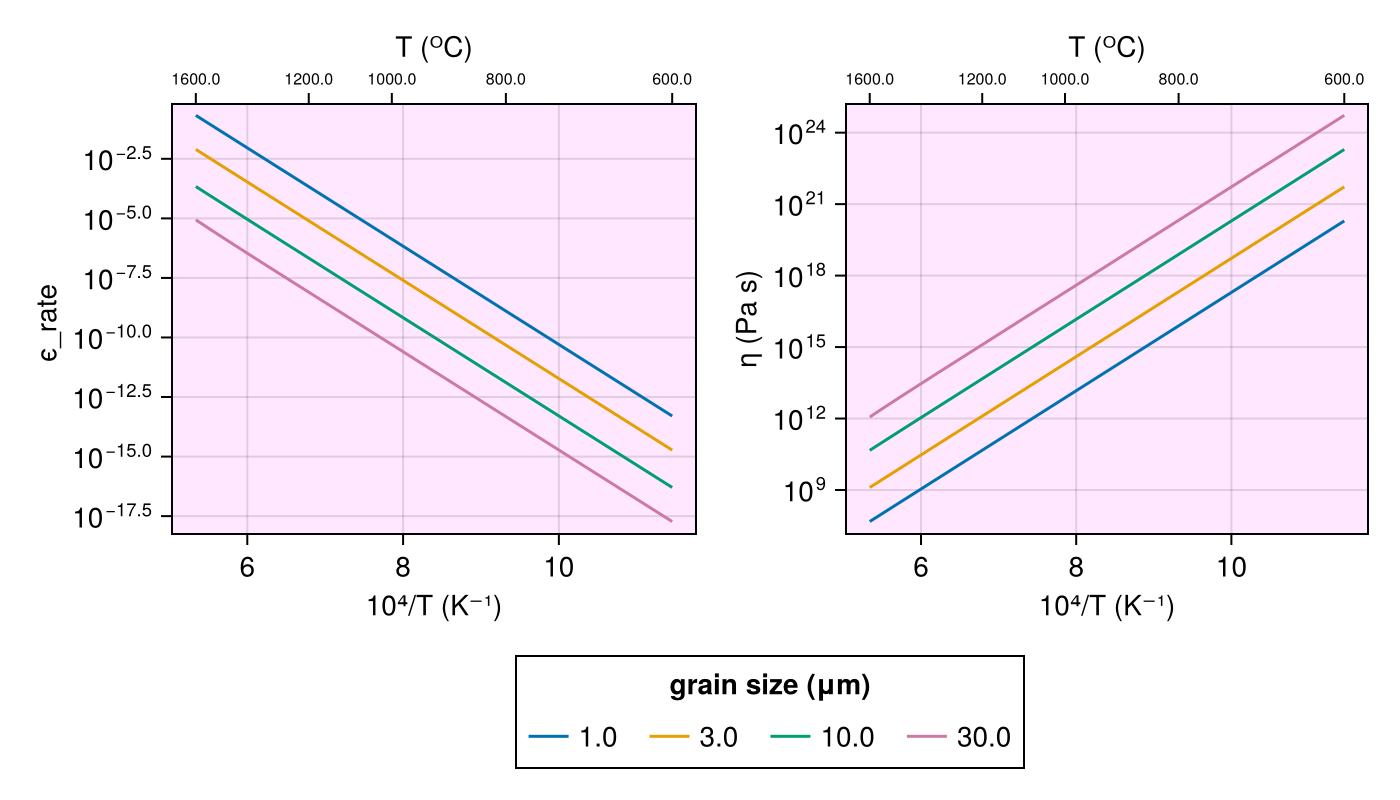
Varying porosity
We can also look at the distribution with parameters by varying just the porosity :
Code for this figure
f = Figure(; size=(700, 400))

T = (600:1600) .+ 273.0
P = 2.0
dg = 4.0
σ = 10e-3
ϕ = [0.01, 0.03, 0.1, 0.3]'

m = HK2003(T, P, dg, σ, ϕ)
resp = forward(m, []);

resp_fields = [:ϵ_rate, :η]
units = ["", "(Pa⋅s)"]

ax_coords = [(1, 1), (1, 2)]
for i in eachindex(resp_fields)
    ax = Axis(f[ax_coords[i]...]; xlabel="10⁴/T (K⁻¹)",
        ylabel=string(resp_fields[i]) * " $(units[i])",
        yticks=LogTicks(WilkinsonTicks(6; k_min=5)), backgroundcolor=(:magenta, 0.052))

    xts = inv.([600, 800, 1000, 1200, 1600] .+ 273.0) .* 1e4

    ax2 = Axis(
        f[ax_coords[i]...]; xaxisposition=:top, yaxisposition=:right, xlabel="T (ᴼC)",
        xgridvisible=false, xtickformat=x -> string.(round.((1e4 ./ x) .- 273)),
        xticklabelsize=8, backgroundcolor=(:magenta, 0.05))
    ax2.xticks = xts
    hidespines!(ax2)
    hideydecorations!(ax2)
    linkyaxes!(ax, ax2)
    ylims!(ax, extrema(getfield(resp, resp_fields[i])) .* (0.3, 3))
    ylims!(ax2, extrema(getfield(resp, resp_fields[i])) .* (0.3, 3))
    ax.yscale = log10
    ax2.yscale = log10

    for j in axes(getfield(resp, resp_fields[i]), 2)
        d = ϕ[j]
        r_ = getfield(resp, resp_fields[i])
        lines!(ax, inv.(T) .* 1e4, r_[:, j]; label="$d")
        lines!(ax2, inv.(T) .* 1e4, r_[:, j]; alpha=0)
    end
end
f[2, 1:2] = Legend(f, f.content[end - 1], "porosity"; orientation=:horizontal)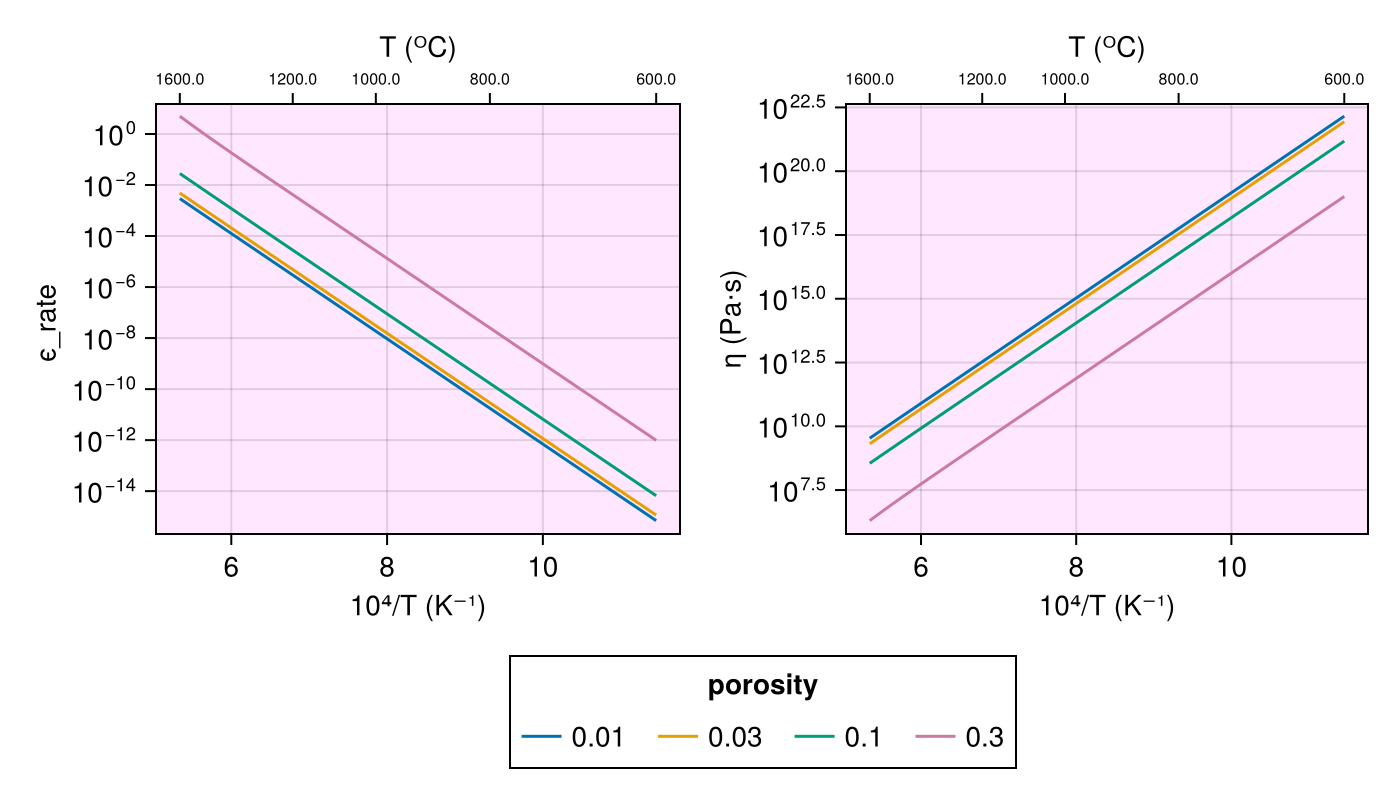
Varying water content
Another important parameter to consider for HK2003 is water content. By default, we assume 0 ppm. The distribution with temperature for different water content (keeping other parameters constant) looks like :
Code for this figure
f = Figure(; size=(700, 400))

T = (600:1600) .+ 273.0
P = 2.0
dg = 4.0
σ = 10e-3
ϕ = 0.015
Ch2o = [0.0, 100.0, 300.0, 1000.0]'

m = HK2003(T, P, dg, σ, ϕ, Ch2o)
resp = forward(m, []);

resp_fields = [:ϵ_rate, :η]
units = ["", "(Pa⋅s)"]

ax_coords = [(1, 1), (1, 2)]
for i in eachindex(resp_fields)
    ax = Axis(f[ax_coords[i]...]; xlabel="10⁴/T (K⁻¹)",
        ylabel=string(resp_fields[i]) * " $(units[i])",
        yticks=LogTicks(WilkinsonTicks(6; k_min=5)), backgroundcolor=(:magenta, 0.052))

    xts = inv.([600, 800, 1000, 1200, 1600] .+ 273.0) .* 1e4

    ax2 = Axis(
        f[ax_coords[i]...]; xaxisposition=:top, yaxisposition=:right, xlabel="T (ᴼC)",
        xgridvisible=false, xtickformat=x -> string.(round.((1e4 ./ x) .- 273)),
        xticklabelsize=8, backgroundcolor=(:magenta, 0.05))
    ax2.xticks = xts
    hidespines!(ax2)
    hideydecorations!(ax2)
    linkyaxes!(ax, ax2)
    ylims!(ax, extrema(getfield(resp, resp_fields[i])) .* (0.3, 3))
    ylims!(ax2, extrema(getfield(resp, resp_fields[i])) .* (0.3, 3))
    ax.yscale = log10
    ax2.yscale = log10

    for j in axes(getfield(resp, resp_fields[i]), 2)
        d = Ch2o[j]
        r_ = getfield(resp, resp_fields[i])
        lines!(ax, inv.(T) .* 1e4, r_[:, j]; label="$d")
        lines!(ax2, inv.(T) .* 1e4, r_[:, j]; alpha=0)
    end
end
f[2, 1:2] = Legend(f, f.content[end - 1], "Water conc. (ppm)"; orientation=:horizontal)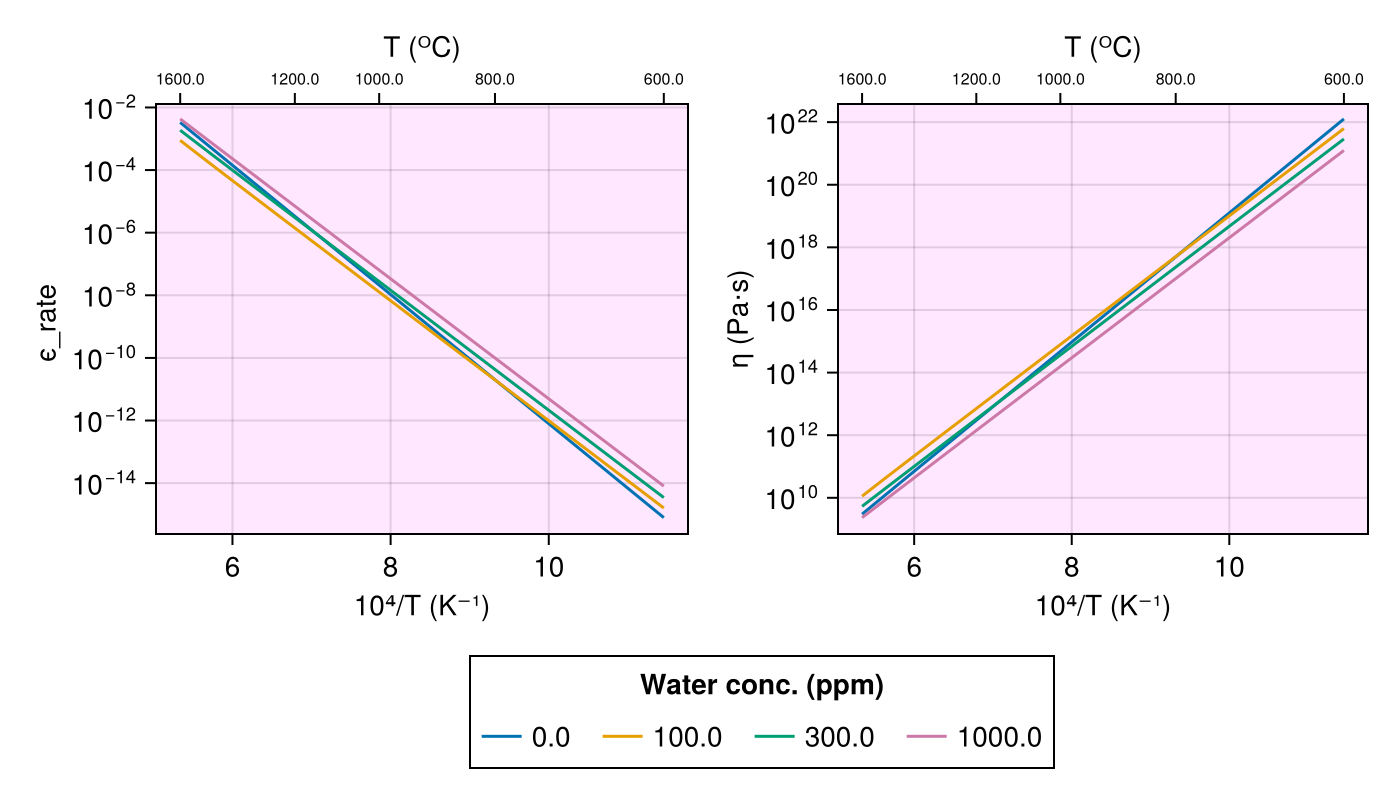
HZK2011
Porosity.HZK2011 Type
HZK2011(T, P, dg, σ, ϕ)Calculate strain rate and viscosity for steady state olivine flow, per Zimmerman and Kohlstedt (2011), using the three creep mechanisms, i.e., diffusion, dislocation, grain boundary sliding
Arguments
- `T` : Temperature of the rock (K)
- `P` : Pressure (GPa)
- `dg`: Grain size (μm)
- `σ` : Shear stress (GPa)
- `ϕ` : Porosity
Keyword Arguments
- `params` : Various coefficients required for calculation.
Coefficients for different mechanisms (stored in `mechs` field):
    - `diff` : Diffusion creep
    - `disl` : Dislocation creep
    - `gbs`  : Grain boundary sliding
To investigate coefficients, call `default_params(Val{HZK2011})`.
To modify coefficients, check the relevant documentation page. This
will also users to get any particular type of mechanism, eg. `diff` only
by setting the `A` in `disl` and `gbs` to `0f0`.

`params` for `HZK2011` holds another important field:
    - `melt_enhancement` : TODO
Usage
julia> T = collect(1073.0f0:40:1273.0f0);

julia> P = 2 .+ zero(T);

julia> dg = collect(3.0f0:8.0f-1:7.0f0);

julia> σ = collect(7.5f0:1.0f0:12.5f0) .* 1.0f-3;

julia> ϕ = collect(1.0f-2:2.0f-3:2.0f-2);

julia> model = HZK2011(T, P, dg, σ, ϕ)
Model : HZK2011
Temperature (K) : Float32[1073.0, 1113.0, 1153.0, 1193.0, 1233.0, 1273.0]
Pressure (GPa) : Float32[2.0, 2.0, 2.0, 2.0, 2.0, 2.0]
grain size(μm) : Float32[3.0, 3.8, 4.6, 5.4, 6.2, 7.0]
Shear stress (GPa) : Float32[0.0075000003, 0.0085, 0.009500001, 0.010500001, 0.011500001, 0.0125]
Porosity : Float32[0.01, 0.012, 0.014, 0.016, 0.018, 0.02]

julia> forward(model, [])
Rock physics Response : RockphyViscous
Strain rate : Float32[8.3687815f-13, 2.4096476f-12, 7.02197f-12, 2.0106366f-11, 5.5824817f-11, 1.4951564f-10]
Viscosity (Pa s) : Float32[8.961879f18, 3.5274867f18, 1.3528968f18, 5.222227f17, 2.060016f17, 8.36033f16]
References
- Hansen, Zimmerman and Kohlstedt, 2011, "Grain boundary sliding in San Carlos olivine: Flow law parameters and crystallographic-preferred orientation", J. Geophys. Res., https://doi.org/10.1029/2011JB008220
Varying grain size
The distribution with temperature looks like (assuming increase in grain size is independent of other parameters) at 2 GPa pressure with a porosity of 0.015:
Code for this figure
f = Figure(; size=(700, 400))

T = (600:1600) .+ 273.0
P = 2.0
dg = [1.0, 3.0, 10.0, 30.0]'
σ = 10e-3
ϕ = 0.015

m = HZK2011(T, P, dg, σ, ϕ)
resp = forward(m, []);

resp_fields = [:ϵ_rate, :η]
units = ["", "(Pa s)"]

ax_coords = [(1, 1), (1, 2)]
for i in eachindex(resp_fields)
    ax = Axis(f[ax_coords[i]...]; xlabel="10⁴/T (K⁻¹)",
        ylabel=string(resp_fields[i]) * " $(units[i])",
        yticks=LogTicks(WilkinsonTicks(6; k_min=5)), backgroundcolor=(:magenta, 0.052))

    xts = inv.([600, 800, 1000, 1200, 1600] .+ 273.0) .* 1e4

    ax2 = Axis(
        f[ax_coords[i]...]; xaxisposition=:top, yaxisposition=:right, xlabel="T (ᴼC)",
        xgridvisible=false, xtickformat=x -> string.(round.((1e4 ./ x) .- 273)),
        xticklabelsize=8, backgroundcolor=(:magenta, 0.05))
    ax2.xticks = xts
    hidespines!(ax2)
    hideydecorations!(ax2)
    linkyaxes!(ax, ax2)
    ylims!(ax, extrema(getfield(resp, resp_fields[i])) .* (0.3, 3))
    ylims!(ax2, extrema(getfield(resp, resp_fields[i])) .* (0.3, 3))
    ax.yscale = log10
    ax2.yscale = log10

    for j in axes(getfield(resp, resp_fields[i]), 2)
        d = dg[j]
        r_ = getfield(resp, resp_fields[i])
        lines!(ax, inv.(T) .* 1e4, r_[:, j]; label="$d")
        lines!(ax2, inv.(T) .* 1e4, r_[:, j]; alpha=0)
    end
end
f[2, 1:2] = Legend(f, f.content[end - 1], "grain size (μm)"; orientation=:horizontal)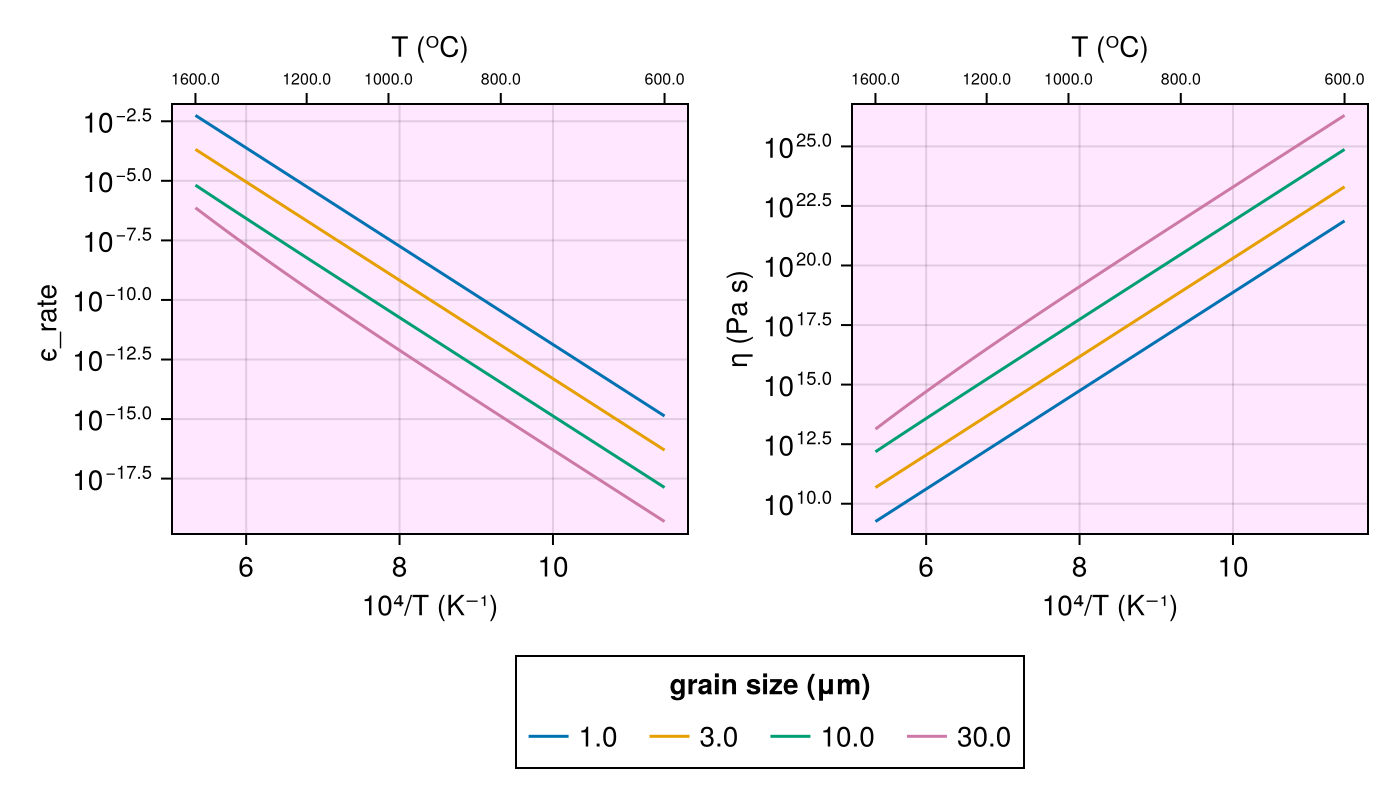
Varying porosity
We can also look at the distribution with parameters by varying just the porosity :
Code for this figure
f = Figure(; size=(700, 400))

T = (600:1600) .+ 273.0
P = 2.0
dg = 4.0
σ = 10e-3
ϕ = [0.01, 0.03, 0.1, 0.3]'

m = HZK2011(T, P, dg, σ, ϕ)
resp = forward(m, []);

resp_fields = [:ϵ_rate, :η]
units = ["", "(Pa⋅s)"]

ax_coords = [(1, 1), (1, 2)]
for i in eachindex(resp_fields)
    ax = Axis(f[ax_coords[i]...]; xlabel="10⁴/T (K⁻¹)",
        ylabel=string(resp_fields[i]) * " $(units[i])",
        yticks=LogTicks(WilkinsonTicks(6; k_min=5)), backgroundcolor=(:magenta, 0.052))

    xts = inv.([600, 800, 1000, 1200, 1600] .+ 273.0) .* 1e4

    ax2 = Axis(
        f[ax_coords[i]...]; xaxisposition=:top, yaxisposition=:right, xlabel="T (ᴼC)",
        xgridvisible=false, xtickformat=x -> string.(round.((1e4 ./ x) .- 273)),
        xticklabelsize=8, backgroundcolor=(:magenta, 0.05))
    ax2.xticks = xts
    hidespines!(ax2)
    hideydecorations!(ax2)
    linkyaxes!(ax, ax2)
    ylims!(ax, extrema(getfield(resp, resp_fields[i])) .* (0.3, 3))
    ylims!(ax2, extrema(getfield(resp, resp_fields[i])) .* (0.3, 3))
    ax.yscale = log10
    ax2.yscale = log10

    for j in axes(getfield(resp, resp_fields[i]), 2)
        d = ϕ[j]
        r_ = getfield(resp, resp_fields[i])
        lines!(ax, inv.(T) .* 1e4, r_[:, j]; label="$d")
        lines!(ax2, inv.(T) .* 1e4, r_[:, j]; alpha=0)
    end
end
f[2, 1:2] = Legend(f, f.content[end - 1], "porosity"; orientation=:horizontal)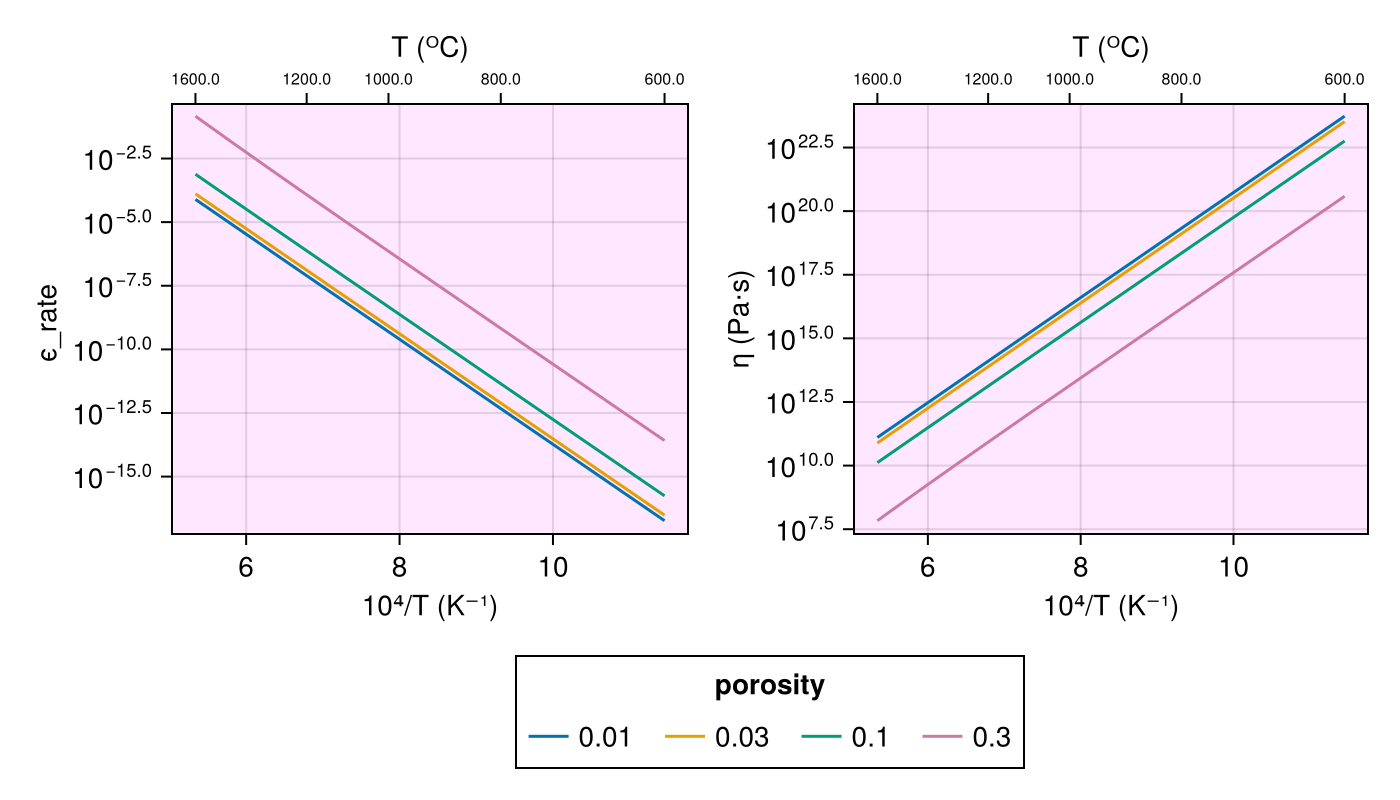
xfit_premelt
Porosity.xfit_premelt Type
xfit_premelt(T, P, dg, σ, ϕ)Calculate viscosity for steady state olivine flow for pre-melting, i.e., temperatures are just below and above the solidus, per Yamauchi and Takei (2016)
Arguments
- `T` : Temperature of the rock (K)
- `P` : Pressure (GPa)
- `dg`: Grain size (μm)
- `σ` : Shear stress (GPa)
- `ϕ` : Porosity
- `T_solidus` : Solidus temperature
Keyword Arguments
- `params` : Various coefficients required for calculation.
Coefficients for different mechanisms (stored in `mechs` field):
    - `diff` : Diffusion creep
    - `disl` : Dislocation creep
    - `gbs`  : Grain boundary sliding
To investigate coefficients, call `default_params(Val{xfit_premelt}())`.
To modify coefficients, check the relevant documentation page. This
will also users to get any particular type of mechanism, eg. `diff` only
by setting the `A` in `disl` and `gbs` to `0f0`.
Usage
julia> T = collect(1073.0f0:40:1273.0f0);

julia> P = 2 .+ zero(T);

julia> dg = collect(3.0f0:8.0f-1:7.0f0);

julia> σ = collect(7.5f0:1.0f0:12.5f0) .* 1.0f-3;

julia> ϕ = collect(1.0f-2:2.0f-3:2.0f-2);

julia> T_solidus = 1200 + 273 .+ zero(T);

julia> model = xfit_premelt(T, P, dg, σ, ϕ, T_solidus)
Model : xfit_premelt
Temperature (K) : Float32[1073.0, 1113.0, 1153.0, 1193.0, 1233.0, 1273.0]
Pressure (GPa) : Float32[2.0, 2.0, 2.0, 2.0, 2.0, 2.0]
grain size(μm) : Float32[3.0, 3.8, 4.6, 5.4, 6.2, 7.0]
Shear stress (GPa) : Float32[0.0075000003, 0.0085, 0.009500001, 0.010500001, 0.011500001, 0.0125]
Porosity : Float32[0.01, 0.012, 0.014, 0.016, 0.018, 0.02]
Solidus Temperature (K) : Float32[1473.0, 1473.0, 1473.0, 1473.0, 1473.0, 1473.0]

julia> forward(model, [])
Rock physics Response : RockphyViscous
Strain rate : Float32[0.0, 0.0, 0.0, 0.0, 0.0, 0.0]
Viscosity (Pa s) : Float32[7.6341115f18, 2.2587335f18, 6.6676584f17, 2.024383f17, 6.40973f16, 2.1291828f16]
References
- Yamauchi and Takei, 2016, "Polycrystal anelasticity at near-solidus temperatures", J. Geophys. Res. Solid Earth, https://doi.org/10.1002/2016JB013316
!!!note
Note that `xfit_premelt` populates the return value of strain rate with zeros. We, therefore, do not plot the same here.Varying grain size
The distribution with temperature looks like (assuming increase in grain size is independent of other parameters) at 2 GPa pressure with a porosity of 0.015 at solidus temperature of 1200 ᴼC:
Code for this figure
f = Figure(; size=(600, 400))

T = (600:1600) .+ 273.0
P = 2.0
dg = [1.0, 3.0, 10.0, 30.0]'
σ = 10e-3
ϕ = 0.015
T_solidus = 1200 + 273

m = xfit_premelt(T, P, dg, σ, ϕ, T_solidus)
resp = forward(m, []);

resp_fields = [:η]
units = ["(Pa s)"]

ax_coords = [(1, 1), (1, 2)]
for i in eachindex(resp_fields)
    ax = Axis(f[ax_coords[i]...]; xlabel="10⁴/T (K⁻¹)",
        ylabel=string(resp_fields[i]) * " $(units[i])",
        yticks=LogTicks(WilkinsonTicks(6; k_min=5)), backgroundcolor=(:magenta, 0.052))

    xts = inv.([600, 800, 1000, 1200, 1600] .+ 273.0) .* 1e4

    ax2 = Axis(
        f[ax_coords[i]...]; xaxisposition=:top, yaxisposition=:right, xlabel="T (ᴼC)",
        xgridvisible=false, xtickformat=x -> string.(round.((1e4 ./ x) .- 273)),
        xticklabelsize=8, backgroundcolor=(:magenta, 0.05))
    ax2.xticks = xts
    hidespines!(ax2)
    hideydecorations!(ax2)
    linkyaxes!(ax, ax2)

    if sum(extrema(getfield(resp, resp_fields[i]))) > 1e-15
        ylims!(ax, extrema(getfield(resp, resp_fields[i])) .* (0.3, 3))
        ylims!(ax2, extrema(getfield(resp, resp_fields[i])) .* (0.3, 3))
        ax.yscale = log10
        ax2.yscale = log10
    end
    for j in axes(getfield(resp, resp_fields[i]), 2)
        d = dg[j]
        r_ = getfield(resp, resp_fields[i])
        lines!(ax, inv.(T) .* 1e4, r_[:, j]; label="$d")
        lines!(ax2, inv.(T) .* 1e4, r_[:, j]; alpha=0)
    end
end

f[1, 2] = Legend(f, f.content[end - 1], "grain size (μm)")

for i in eachindex(f.content[1:(end - 1)])
    ax_ = f.content[i]
    lv = vlines!(ax_, 1e4 / T_solidus; color=:green, linestyle=:dash)
    axislegend(
        ax_, [lv], ["solidus temperature"]; position=:rb, labelsize=12, framevisible=false)
end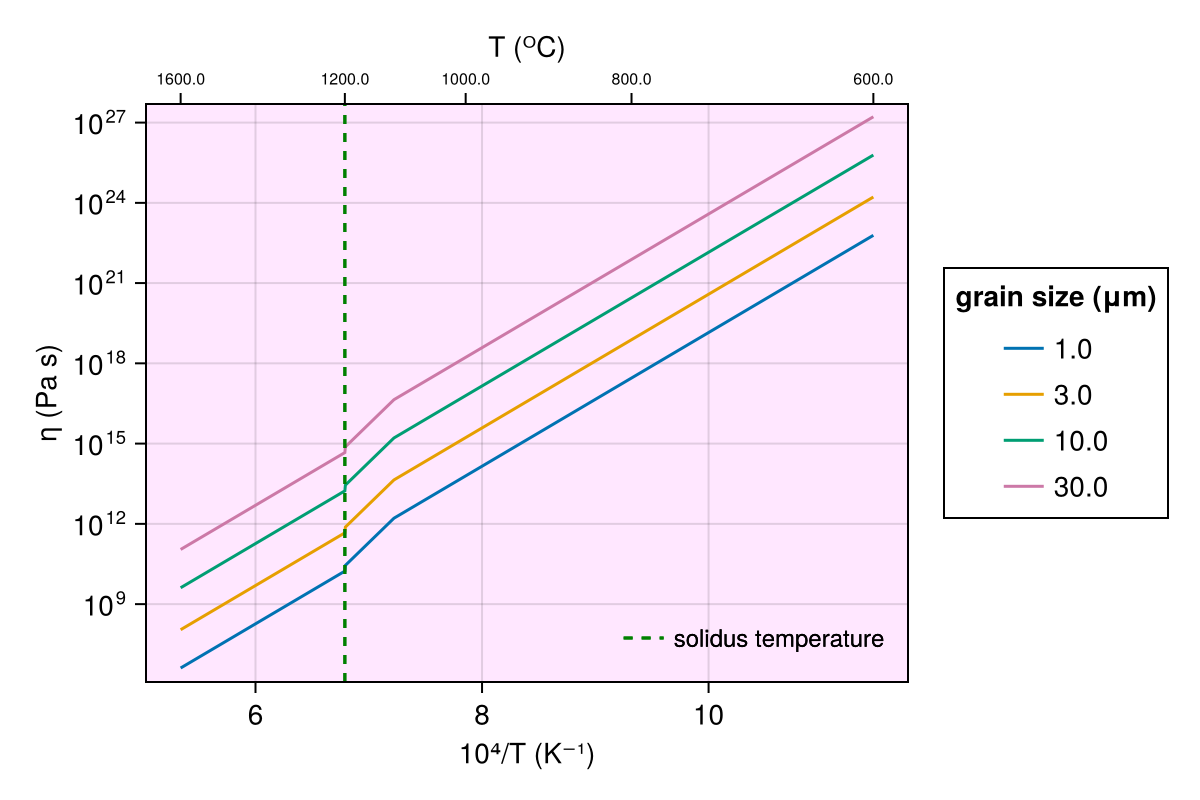
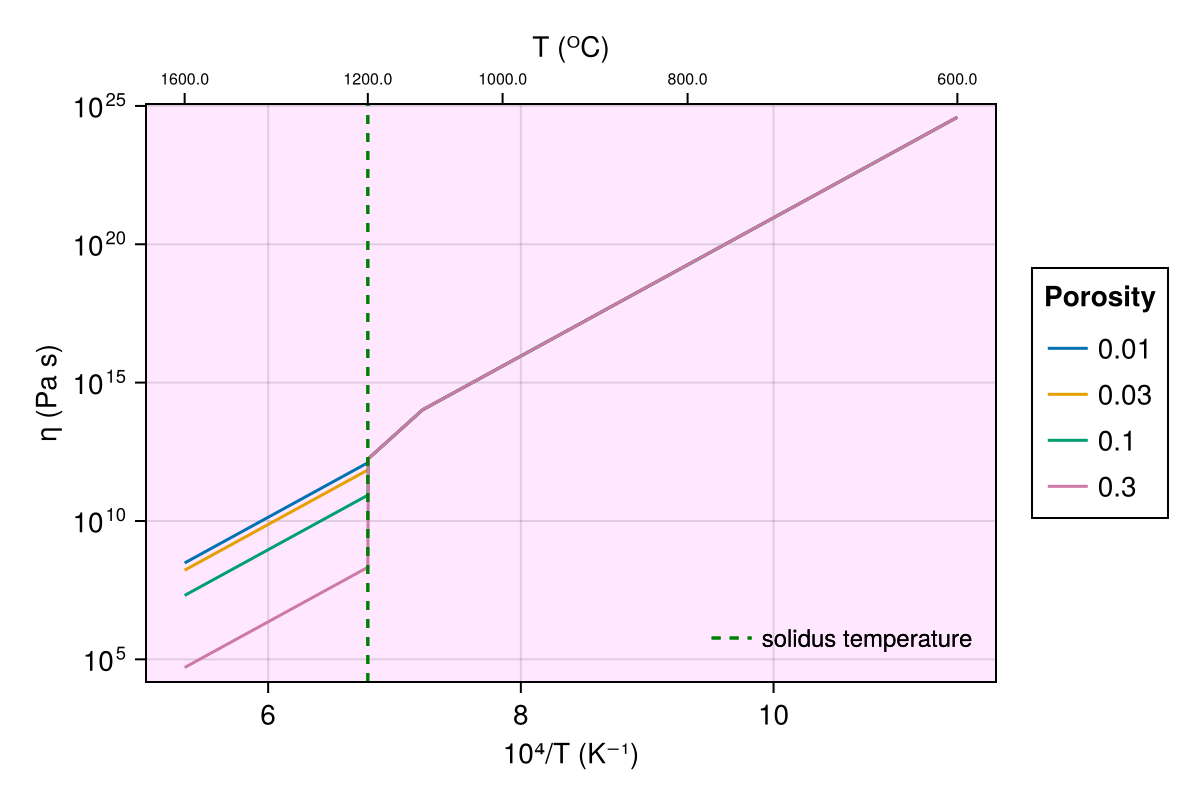
Varying porosity
We can also look at the distribution with parameters by varying just the porosity :
Code for this figure
f = Figure(; size=(600, 400))

T = (600:1600) .+ 273.0
P = 2.0
dg = 4.0
σ = 10e-3
ϕ = [0.01, 0.03, 0.1, 0.3]'
T_solidus = 1200 + 273

m = xfit_premelt(T, P, dg, σ, ϕ, T_solidus)
resp = forward(m, []);

resp_fields = [:η]
units = ["(Pa s)"]

ax_coords = [(1, 1), (1, 2)]
for i in eachindex(resp_fields)
    ax = Axis(f[ax_coords[i]...]; xlabel="10⁴/T (K⁻¹)",
        ylabel=string(resp_fields[i]) * " $(units[i])",
        yticks=LogTicks(WilkinsonTicks(6; k_min=5)), backgroundcolor=(:magenta, 0.052))

    xts = inv.([600, 800, 1000, 1200, 1600] .+ 273.0) .* 1e4

    ax2 = Axis(
        f[ax_coords[i]...]; xaxisposition=:top, yaxisposition=:right, xlabel="T (ᴼC)",
        xgridvisible=false, xtickformat=x -> string.(round.((1e4 ./ x) .- 273)),
        xticklabelsize=8, backgroundcolor=(:magenta, 0.05))
    ax2.xticks = xts
    hidespines!(ax2)
    hideydecorations!(ax2)
    linkyaxes!(ax, ax2)

    if sum(extrema(getfield(resp, resp_fields[i]))) > 1e-15
        ylims!(ax, extrema(getfield(resp, resp_fields[i])) .* (0.3, 3))
        ylims!(ax2, extrema(getfield(resp, resp_fields[i])) .* (0.3, 3))
        ax.yscale = log10
        ax2.yscale = log10
    end
    for j in axes(getfield(resp, resp_fields[i]), 2)
        d = ϕ[j]
        r_ = getfield(resp, resp_fields[i])
        lines!(ax, inv.(T) .* 1e4, r_[:, j]; label="$d")
        lines!(ax2, inv.(T) .* 1e4, r_[:, j]; alpha=0)
    end
end

f[1, 2] = Legend(f, f.content[end - 1], "Porosity")

for i in eachindex(f.content[1:(end - 1)])
    ax_ = f.content[i]
    lv = vlines!(ax_, 1e4 / T_solidus; color=:green, linestyle=:dash)
    axislegend(
        ax_, [lv], ["solidus temperature"]; position=:rb, labelsize=12, framevisible=false)
end